Why Labs Put QBench at the Top of G2's Fall 2026 LIMS Grid

Labs don't choose a LIMS because a vendor sounds convincing on a website. They choose based on what other labs tell them.
In G2's Fall 2026 reports, labs put QBench at #1 on the Grid® Report for LIMS.
That ranking carries more weight than most, because the Grid is the one report that requires two things at once: the highest satisfaction scores in the category, and the market presence to back them up. You can't reach the top by being new and well-liked. You can't reach it by being large, either. You get there when a meaningful number of labs run a product and rate it above everything else they could have bought.
If you're evaluating LIMS platforms right now, here's the practical translation: the labs already running QBench rate their experience higher than labs running any other LIMS in the category rate theirs.
That's the story worth telling. Below is what those labs are actually validating.
What Labs Are Validating
We've built QBench around four things: software your team can use without a specialist, support from people who have worked in labs, a platform that changes as fast as your lab does, and returns you can point to. The Fall 2026 reports are our customers confirming all four.
A LIMS Your Team Will Actually Use
QBench ranked #1 on the Usability Index for LIMS, a position we've now held for multiple consecutive cycles.
Usability is not a soft metric in a lab. It decides whether the system you bought becomes the system your team works in, or a database two people maintain while everyone else keeps a side spreadsheet. Powerful software nobody adopts produces the same result as no software at all.
Ranking first here means analysts at the bench pick QBench up quickly, new hires get productive in days rather than months, and your lab manager can add a field, adjust a workflow, or build a report without filing a ticket. That's what our no-code configuration tools are for, and it's why labs run QBench without an IT team behind it.
"If you can imagine it, you can develop it on QBench." -Nick Culhane, Lab Manager at Akoya Biosciences
A Team That Knows Your Work
QBench ranked #1 on the Relationship Index for LIMS and #1 in the small-business segment.
G2 builds that index from three things reviewers rate directly: ease of doing business with, quality of support, and likelihood to recommend. It's the closest thing in the report to a measure of what the vendor relationship actually feels like after the contract is signed.
Our implementation and account management teams are staffed with former lab managers and technicians. When you describe a chain-of-custody gap or a COA that needs to look a specific way for a specific client, you're not explaining your job before you can ask your question.
Smaller labs feel this most, because they're usually the first accounts a large vendor deprioritizes. Holding #1 in both the overall and small-business segments says we've gone the other direction.
A Platform That Grows With Your Lab
QBench ranked #1 on the Momentum Grid® Report for LIMS.
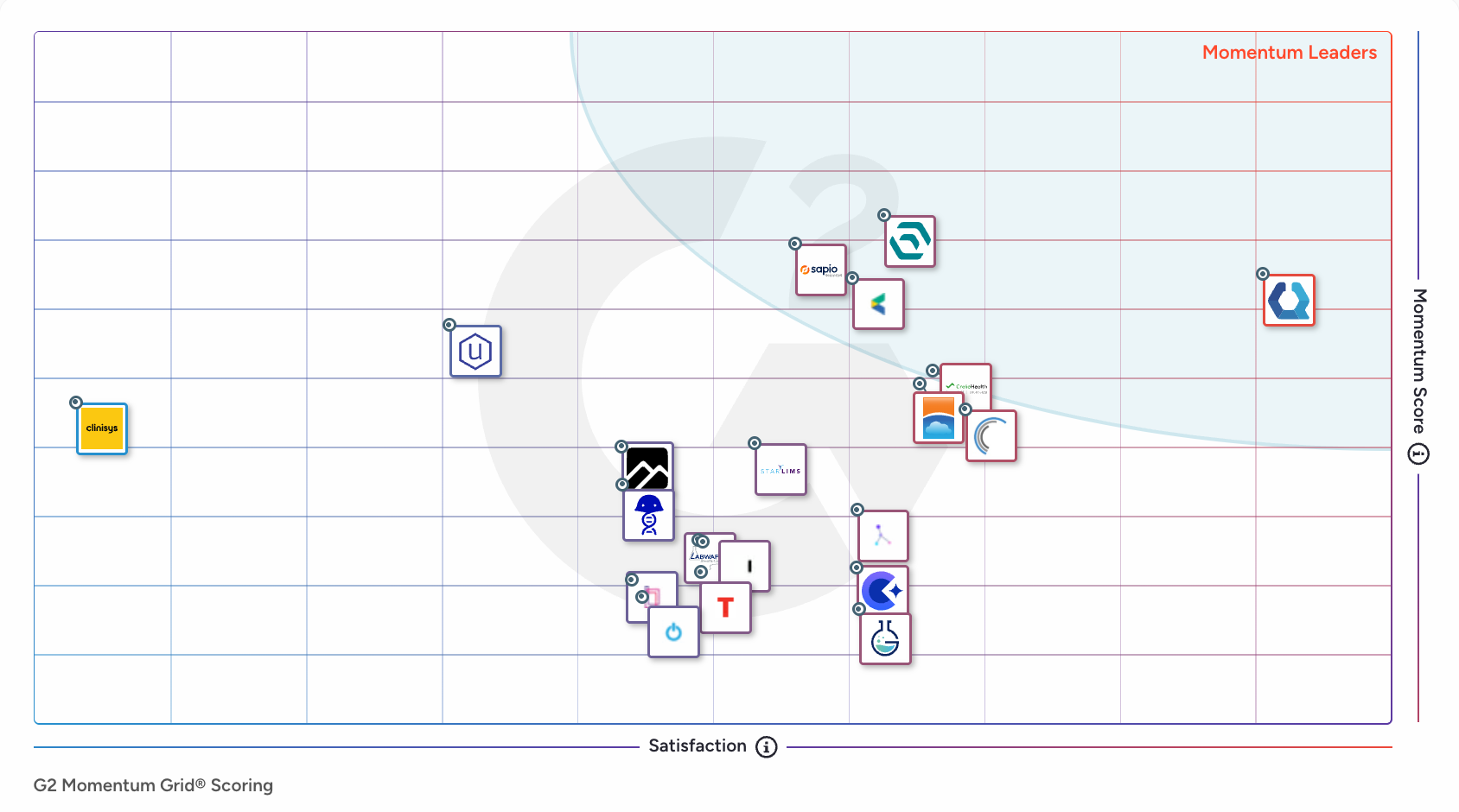
Momentum measures trajectory rather than position: user satisfaction, employee growth, and digital presence. It answers a question that only becomes urgent in year three. When your methods change, your instrument list expands, or a regulatory body moves the requirements, does your LIMS keep up?
We ship product updates every two weeks. Many platforms in this category ship meaningful updates once a year. Over a five-year contract, that difference compounds into either a system that grew with you or one you've built workarounds around.
They were "...able to scale QBench alongside us as our processes have grown more complex." -Jonah George, Founding Engineer at Light Labs
Returns Your Lab Can Point To
QBench ranked #2 on the Results Index for LIMS, which G2 builds from reported ROI, payback period, and user adoption.
Those three move together. A configurable system your staff adopts quickly starts returning hours in weeks rather than quarters, and the hours come from the unglamorous places: sample login, transcription between systems, chasing a result across three spreadsheets, assembling a COA by hand.
If you'd rather calculate that for your own lab than take an index's word for it, our free LIMS ROI assessment runs the numbers against your sample volume and staffing.
The Full Fall 2026 Results
QBench ranked in 24 G2 Fall 2026 reports across the LIMS and Lab Inventory Management categories, earning 12 badges and six first-place finishes.
.png)
Beyond the badges, QBench placed in the top five in 10 of 12 LIMS reports and 8 of 12 Lab Inventory Management reports, including #2 on the Results Index in both categories. A few rankings moved down from Summer, including the Implementation Index for LIMS, where we placed 6th. Implementation is where we're focused next, and if rollout risk is your main concern, our implementation guide is the place to start.
Worth knowing about how these reports work: every ranking comes from verified reviewers who confirm their identity and product use before a review publishes. Grid reports plot satisfaction against market presence across the whole category. Index reports rank products on one dimension, like usability or relationship. Segment reports break the same data out by company size, which is why the small-business and mid-market versions often matter more to a specific lab than the overall report does.
What This Means If You're Evaluating a LIMS
Strip away the badge count and the Fall 2026 reports describe a specific kind of product, validated by the labs using it.
QBench is the right fit if you want a cloud-based LIMS your own team configures and changes, backed by people who understand lab operations, on a platform that keeps moving. That describes most small-business and mid-market testing, manufacturing, food and beverage, life sciences, agriculture, and environmental labs, and it's where we consistently rank first.
If your requirement is a vendor-run, multi-site global validation program with a large professional services organization managing it, an enterprise platform is likely the better match. We'd rather tell you that now. If your constraint is regulatory, start with our security and compliance documentation.
For a broader look at the category, including where competitors are strong, see our breakdown of the best LIMS of 2026 or our guide to how to choose a LIMS.
Ready to Learn More?
Rankings are a starting point. The better test is whether a LIMS handles the work your lab actually does.
Bring us your hardest workflow, the one with the exception handling nobody wants to document, and we'll show you how it runs in QBench.
Frequently Asked Questions
Is QBench the Top-Ranked LIMS on G2?
Yes. In G2's Fall 2026 reports, QBench ranked #1 on the Grid® Report for LIMS, G2's overall ranking for the category. QBench also ranked #1 on the Small-Business Grid® Report for LIMS and #2 on the Mid-Market Grid® Report for LIMS.
What is the G2 Grid® Report for LIMS?
The G2 Grid® Report for LIMS plots laboratory information management systems on two axes: satisfaction, based on verified user reviews, and market presence, based on factors including company size, deployment scale, and digital footprint.
What G2 Badges Did QBench Earn in Fall 2026?
QBench earned 12 badges across 24 Fall 2026 reports: seven in LIMS and five in Lab Inventory Management. The LIMS badges came from the Grid® Report, the Small-Business Grid® Report, the Mid-Market Grid® Report, the Usability Index, the Relationship Index, the Small-Business Relationship Index, and the Momentum Grid® Report. The Lab Inventory Management badges came from the Grid® Report, the Mid-Market Grid® Report, the Momentum Grid® Report, the Implementation Index, and the Small-Business Implementation Index.
What's the Difference Between a G2 Grid Report and a G2 Index Report?
A Grid report plots satisfaction against market presence across an entire category. An Index report ranks products on a single dimension, such as usability, results, relationship, or implementation.
Which LIMS is Easiest to Use?
In G2's Fall 2026 reports, QBench ranked #1 on the Usability Index for LIMS, a position it has held for multiple consecutive cycles. G2 builds the index from verified user ratings of how easy a product is to use, set up, and administer.
How Many Reviews Does QBench Have on G2?
QBench holds a 4.6 out of 5 rating across 150 verified reviews on G2.
Which Labs is QBench a Good Fit For?
QBench fits labs that want a configurable system their own staff can adjust without custom code, typically small-business through mid-market testing, manufacturing, food and beverage, life sciences, agriculture, and environmental labs. Labs requiring a vendor-managed, multi-site global validation program with a large professional services organization may be better served by an enterprise platform.

.png)
.png)
.png)

.png)